Repair & Remanufacturing | Reliability Enhancement & Hardening | Advanced Design

Production & Tooling

Gicam technology can use DED laser cladding to rebuild large, expensive tools, such as injection molds, foundry molds, glass molds, stamping dies, cutting tools, and semiconductor equipment components. It targets only the worn area and creates conformal cooling channels to extend the life of the tools and improve their performance.
Manufacturing & Prototyping

Screws and plastic injection molds

In addition to repairs, DED manufactures cooling channels that conform to the part's geometry—something that conventional machining cannot achieve.
Mold cavities wear out locally in areas subject to high stress (injection points, sharp edges, ejection friction zones), while the solid block remains generally intact. DED allows these areas to be precisely rebuilt using a compatible tool steel, followed by re-machining to the correct dimensions, thereby avoiding the need to remanufacture an entire block—a process that is often costly in terms of material and machining.

But the major benefit of DED here goes beyond repair: it enables the creation of conformal cooling channels that follow the geometry of the mold cavity rather than straight boreholes, which significantly improves thermal regulation and, consequently, the production rate and quality of the injection-molded parts. This is a key differentiator compared to conventional machining, which cannot produce this type of complex internal geometry.

Optimized cooling → Channels that follow the geometry of the mold cavity, for improved production rate and quality.
Reloaded mold → Injection and ejection areas repaired without having to remake the entire block.
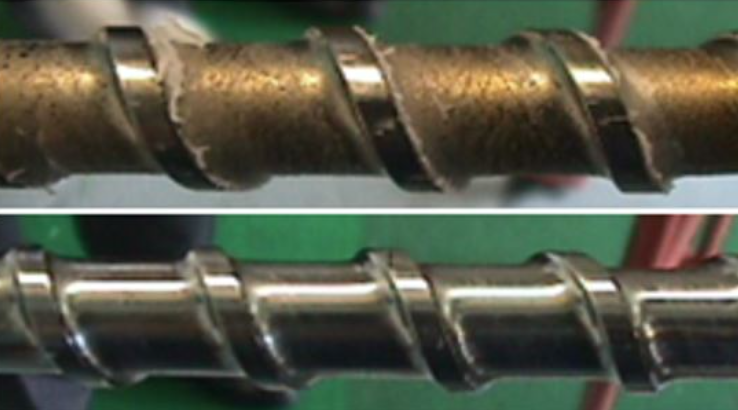
Screws and plastic injection molds
Photo: Nalbarian - Wikimedia Commons — License — modified image

FAQ

What is conformal cooling?

These are cooling channels that follow the shape of the mold cavity, rather than straight holes. They provide better temperature control, which in turn improves the production rate and quality of the injection-molded parts.

Why can't conventional machining do the same thing?