
Repair & MRO | Hybrid Manufacturing | Multi-Material

Aeronautics & Space

Gicam technology can repair and manufacture critical aerospace components using laser-based direct energy deposition (DED): turbine blades, titanium housings, landing gear structures, and rocket engines. It enables precise, multi-material deposition with the fine metallurgical control required by civil and military MRO.
Repair & Remanufacturing

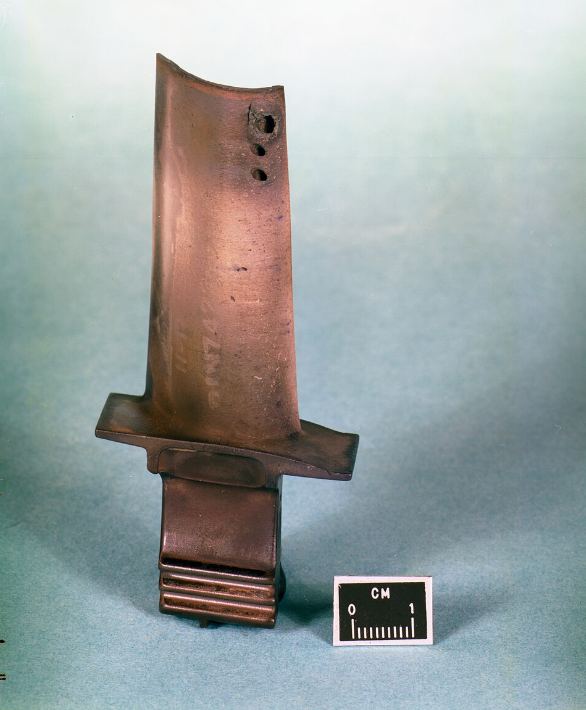
Repair of Superalloy Turbine Blades

A turbine blade is expensive to manufacture and is often damaged only at the tip or leading edge: repairing it locally rather than replacing it changes the economic equation.
These blades are expensive to manufacture and are often damaged only at the tip or leading edge—replacing the entire part therefore makes no economic sense. DED excels at this type of localized repair: Gicam can precisely deposit material only on the damaged area, without remelting the rest of the blade, using a laser spot adjustable down to 0.3 mm upon request for the most delicate repairs.

The real technical challenge is not the deposition itself, but controlling the thermal cycle. Repairing nickel-based superalloys requires precise control of this cycle to limit residual stresses, deformations, and the risk of cracking—a poorly controlled repair can weaken an undamaged area rather than repair the damaged one. This is why this application is considered one of the most industrially mature for laser DED: it has been proven through numerous repair cycles in MRO (Maintenance, Repair & Overhaul), in both civil and military contexts.

Beyond the immediate economic benefit, this approach strengthens autonomy over critical spare parts: rather than relying exclusively on a supply chain for new parts—which can sometimes be lengthy or strained for certain part numbers—an MRO operator can repair and return an existing blade to service. This is an increasingly strategic issue, both for military fleets and for civilian engine manufacturers facing extended lead times for replacement parts.
Spot repair → Only the damaged area is repaired; no complete replacement is necessary.
Parts Sovereignty for Critical Parts → Less reliance on lead times for new parts.
Repair of Superalloy Turbine Blades
Photo: Donald Huebler - Wikimedia Commons — License — modified image

FAQ

Does DED allow for the repair of a turbine blade without having to completely remelt it?

Yes: that is precisely the advantage of this process. The deposit remains confined to the damaged area (tip or leading edge); the heat input remains highly localized around the repaired area.

Which superalloys are compatible with this repair?