
Repair & Remanufacturing | Reliability Enhancement & Hardening | Advanced Design

Production & Tooling

Gicam technology can use DED laser cladding to rebuild large, expensive tools, such as injection molds, foundry molds, glass molds, stamping dies, cutting tools, and semiconductor equipment components. It targets only the worn area and creates conformal cooling channels to extend the life of the tools and improve their performance.
Repair & Remanufacturing

Glass molds: roughing and finishing

Intense thermal shock with every cycle, numerous standardized mold sets: reloading the cavity prevents costly remelting.
Ces moules, généralement en fonte grise, fonte à graphite sphéroïdal ou alliages cuivreux, subissent un choc thermique cyclique intense à chaque cycle de moulage (contact avec le verre en fusion à plus de 1000 °C, puis refroidissement), provoquant une fatigue thermique, un faïençage de surface et une oxydation localisée sur l'empreinte. Le DED permet de recharger précisément les zones dégradées de l'empreinte avec un alliage plus résistant à la fatigue thermique et à l'oxydation, suivi d'un réusinage aux cotes pour restaurer l'état de surface, critique pour l'aspect final du verre.

Cette réparation évite de refondre un moule complet, une opération coûteuse et à délai relativement long pour des séries de moules souvent nombreuses et normalisées. Le procédé présente aussi un intérêt en conception avancée pour optimiser les canaux d'évacuation des gaz (events) ou la conductivité thermique locale de l'empreinte, deux paramètres clés pour la cadence et la qualité de production, difficiles à ajuster finement avec les procédés de fonderie classiques.
Restored surface condition → Mold refilled and then re-machined, which is critical to the final appearance of the glass.
Advanced Design → Optimizable vents and local thermal conductivity, which are difficult to achieve in conventional casting.
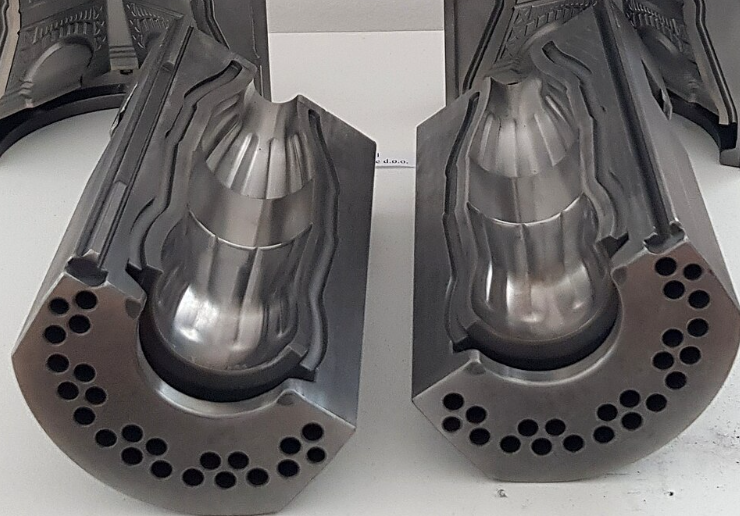
Glass Molds - Roughing and Finishing Machines
Photo: Zenwort - Wikimedia Commons — License — modified image

FAQ

Why is the surface finish of the mold so important?

Because it determines the final appearance of the glass: re-machining to the correct dimensions after re-coating restores this surface finish.

Can DED improve the mold beyond just repairing it?