Repair & Remanufacturing | Reliability Enhancement & Hardening | Industrial Availability

Heavy Industry & Process

Gicam technology can use DED laser cladding to repair large, expensive components used in the steel, cement, paper, and material handling industries, such as cylinders, bands, rollers, and rollers. It targets only the worn area, without replacing the entire component, to minimize production downtime.
Reliability Improvement & Hardening

Hammers and Rotors for Impact Crushers

It is difficult to achieve a balance between hardness and toughness with a single material: additive manufacturing addresses these two requirements separately.
These primary crushing tools are subjected to repeated impacts and severe abrasive wear when in contact with limestone blocks or other hard raw materials, placing heavy stress on the striking edge while requiring good impact resistance in the hammer body. DED allows for localized cladding of the impact zone with a hard alloy without weakening the entire component—a balance between hardness and toughness that is difficult to achieve with a single material using conventional casting.

This approach extends the service life of mass-produced wear parts, which are subject to high unit costs and frequent replacement in cement plants. It also allows the deposited alloy grade to be tailored to the hardness of the raw material being processed—a significant advantage that varies from one quarry to another.

Hardness-toughness trade-off → Hard impact zone, while the hammer body remains impact-resistant.
Adjustable shade → The deposited material may vary depending on the hardness of the raw material being processed.
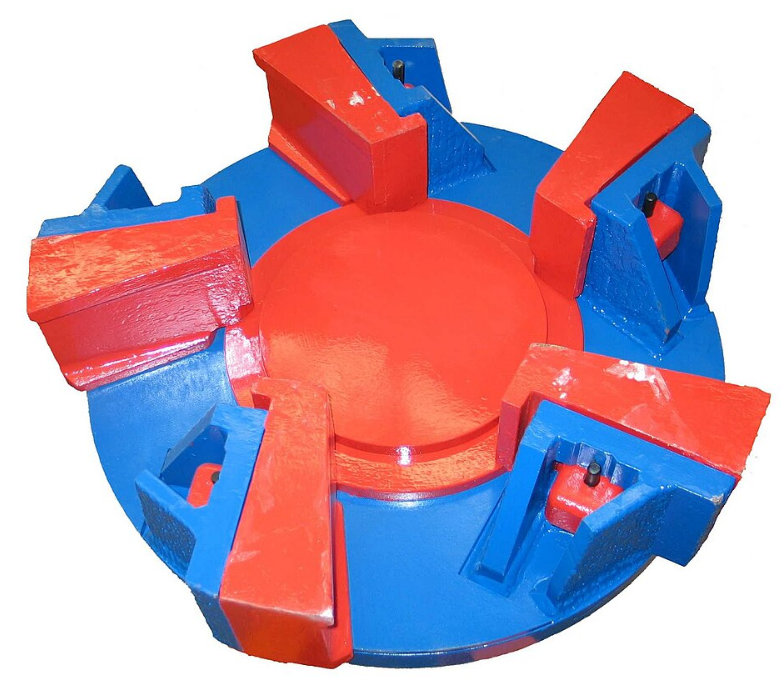
Hammers and Rotors for Impact Crushers
Photo: Luis Ciria - Wikimedia Commons — License — modified image

FAQ

Why not just make the entire hammer out of a very hard alloy?

Because a single, very hard material is too brittle to withstand repeated impacts— DED makes it possible to combine an impact-resistant body with a very hard impact zone, a balance that is difficult to achieve in conventional casting.

Can the material be adapted depending on the quarry where the raw material comes from?