Precision Manufacturing | Porous Structures | Customization on a Per-Unit Basis

Health

Gicam technology can use DED laser manufacturing to produce biological features that are difficult to achieve by other means: gradient-porous structures, bifunctional surfaces, and implants customized to the patient’s anatomy. Here, the focus is less on repair and more on precision manufacturing, in accordance with biocompatibility requirements and regulatory traceability standards.
  • Home
  • Health
  • Customized Cranio-Maxillofacial Implants (PSI)
Manufacturing & Prototyping

Customized Cranio-Maxillofacial Implants (PSI)

Because they cannot be standardized by their very nature, these implants are custom-made based on the patient's CT scan, and the turnaround time is clinically significant.
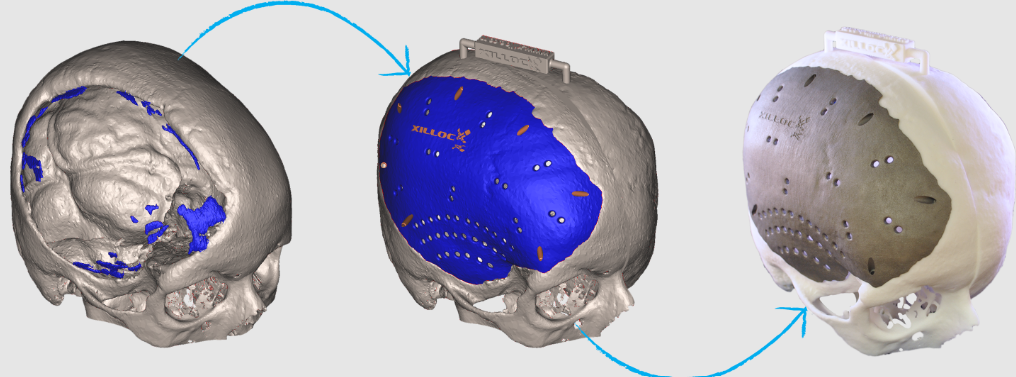
These bone reconstruction implants (skull, jaw, orbit) used following trauma, tumors, or malformations require a unique geometry that is perfectly tailored to the patient’s anatomy based on CT scan images. DED enables the production of these titanium parts on a single-unit or very small-batch basis, with complete geometric freedom and the potential for a porous structure at the periphery to promote tissue integration.

This approach is particularly relevant because these implants, by their very nature, cannot be standardized, making conventional manufacturing processes (machining, forging) costly and time-consuming for single-unit parts. The reduced manufacturing lead time is also a significant clinical consideration, particularly in post-traumatic reconstructive surgery where prompt treatment is critical.

One-of-a-kind piece → Titanium manufactured individually or in very small batches based on scan data.
Reduced Healing Time → A Clinical Challenge in Post-Traumatic Reconstructive Surgery.
Custom Cranio-Maxillofacial Implants - PSI
Photo: Maikel Beerens, Xilloc - Wikimedia Commons — License — modified image

FAQ

Why is DED suitable for single implants?

Because it offers complete geometric freedom without the need for specialized tools, whereas machining or forging are costly and time-consuming for one-off parts.

Are these implants subject to any regulations?