Repair & Remanufacturing | Reliability Enhancement & Hardening | Fleet Availability

Mobility & Infrastructure

Gicam technology can use DED laser cladding to repair fleet components exposed to abrasive wear and impact, such as railroad wheels and axles, turnouts, bucket teeth, plow blades, and tracks. It targets only the worn area, without replacing the entire component, to minimize downtime for machinery and rolling stock.
Reliability Improvement & Hardening

Bucket teeth and wear plates

Constant contact with rock, gravel, and sand: harden only the cutting edge without weakening the body of the tooth.
These parts operate in direct and constant contact with abrasive substrates (rock, gravel, sand), which causes rapid and predictable wear concentrated on the cutting edge.

DED allows these areas to be cladding with very high-hardness alloys (tungsten carbides, reinforced manganese steels) while retaining a tooth body made of tough steel, which is less expensive and more impact-resistant. This combination optimizes the hardness-to-toughness trade-off, which is difficult to achieve with a single material.

It is also an excellent candidate for in-service hardfacing, allowing for the regrinding and extended use of standardized parts produced in very large volumes, where unit cost is a major consideration.

Balance between hardness and toughness → Very hard cutting edge, tough and impact-resistant tooth body.
Regrinding during service life → Repeated re-grinding of parts produced in very large batches.
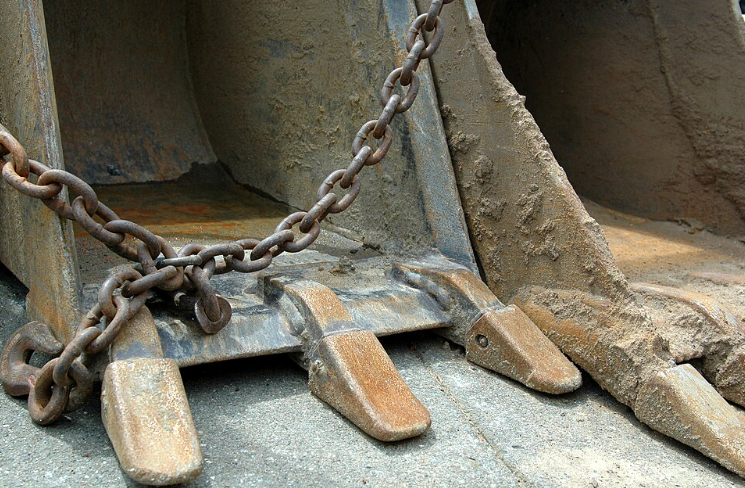
Bucket teeth and wear plates
Photo: DeWitt Clinton - Wikimedia Commons — License — modified image

FAQ

Why not make the entire tooth out of a very hard alloy?

Because a single, very hard material is too brittle to withstand impacts: the DED combines a tough body with a very hard edge.

Can the same bucket tooth be recharged multiple times?