
Repair & Remanufacturing | Reliability Enhancement & Hardening | Manufacturing & Prototyping

Energy & Environment

Gicam technology can use DED laser cladding to repair critical components in the energy and environmental sectors, such as wind turbine shafts and hubs, turbine blades, wellheads, and process valves. It enables targeted cladding and anti-corrosion coatings on expensive equipment with long manufacturing lead times.
Reliability Improvement & Hardening

Anti-corrosion cladding for nuclear components

Tank nozzles, flanges, supports: Protect a low-alloy steel substrate from the primary corrosive environment using a qualified and inspected weld bead.
Certain structural components of the primary circuit (vessel taps, flanges, supports) require a stainless steel or nickel-based alloy cladding to protect a low-alloy steel substrate from the corrosive primary environment.

DED enables the deposition of this cladding with precise metallurgical control (dilution, absence of defects, limited heat-affected zone), a major safety consideration in this sector where each weld bead undergoes rigorous qualification and non-destructive testing.

This technique replaces or complements older cladding processes (ESSC, plating) by offering higher productivity and greater geometric flexibility on complex components. DED is also used in repair and maintenance programs for existing power plants, where the fabrication of new, qualified components is time-consuming and costly.
Precision metallurgical control → Controlled dilution, absence of defects, limited heat-affected zone.
Geometric flexibility → A viable alternative to older processes (ESSC, plating) for complex parts.
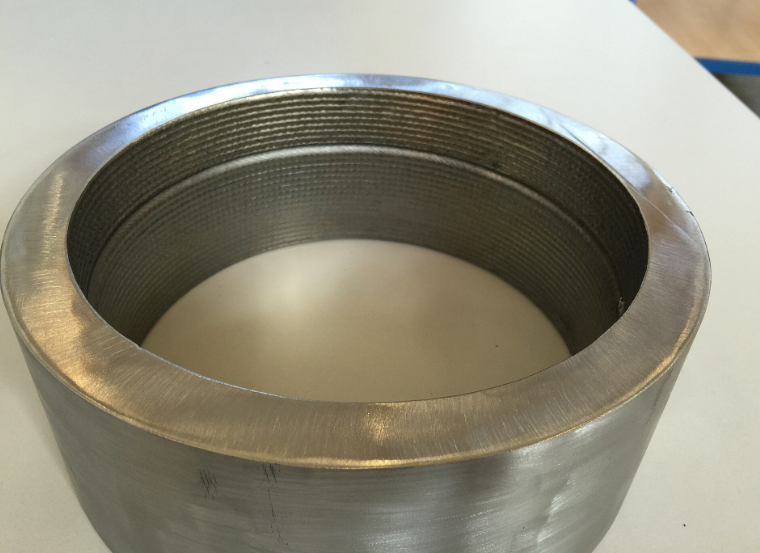
Anti-corrosion cladding for nuclear components
Photo: JP1308 - Wikimedia Commons — CC0 1.0 — modified image

FAQ

Is DED suitable for cladding critical nuclear components?

Yes, the process allows for precise metallurgical control (dilution, absence of defects) that meets the industry’s qualification requirements—however, each application will still be subject to project-specific nondestructive testing and qualification.

Does DED replace traditional cladding processes?