Repair & Remanufacturing | Reliability Enhancement & Hardening | Tight Tolerances

Power Transmission

Gicam technology can use DED laser resurfacing to restore precision rotating components in power transmission systems, such as gear shafts and housings, cylinder rods, and pump impellers and shafts. It targets only the worn areas—bearing surfaces, splines, and bores—while maintaining concentricity and balance tolerances.
Manufacturing & Prototyping

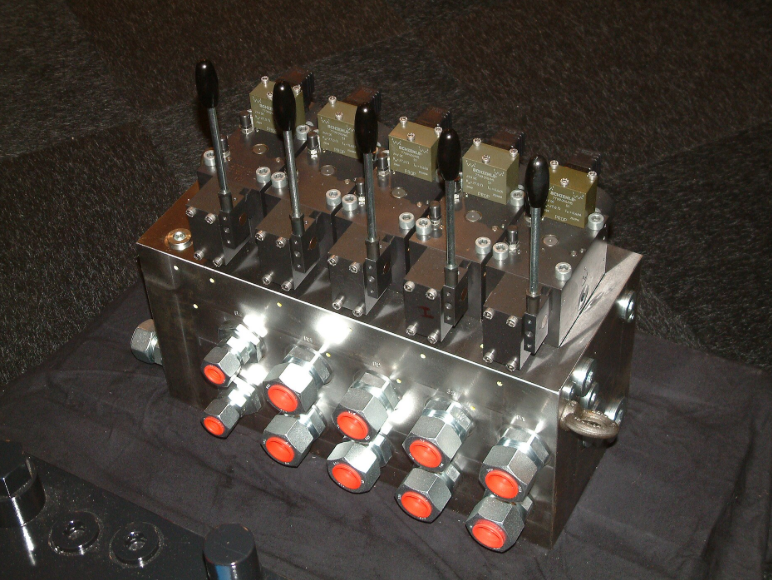
Hydraulic distribution blocks and manifolds

A buy-to-fly ratio that is often unfavorable for blocks machined from solid stock: DED produces a near-net-shape blank and customizes a standard block.
Ces blocs, comme les sièges de soupapes et les pistons associés, sont généralement usinés dans la masse à partir d'un bloc massif, avec un ratio matière achetée/matière volée (buy-to-fly) souvent défavorable. Le DED permet de fabriquer une ébauche quasi-nette (near-net-shape), réduisant considérablement le temps d'usinage et le gaspillage de matière, particulièrement intéressant en petites séries ou prototypes.

La technologie permet aussi la personnalisation d'un bloc standard par ajout de bossages spécifiques à une application. Cela raccourcit les délais de développement pour des circuits hydrauliques sur mesure.

Near-net-shape blank → Less machining time and less material waste, especially for small production runs and prototypes.
Customized standard block → Addition of application-specific protrusions.
Hydraulic distribution blocks and manifolds
Photo: S.J. de Waard - Wikimedia Commons — License — modified image

FAQ

Why does DED reduce the cost of a hydraulic block?

Because it places material exactly where it's needed, the near-net-shape blank improves the buy-to-fly ratio and reduces machining time.

Is DED suitable for hydraulic circuit prototypes?