Repair & Remanufacturing | Reliability Enhancement & Hardening | Fleet Availability

Mobility & Infrastructure

Gicam technology can use DED laser cladding to repair fleet components exposed to abrasive wear and impact, such as railroad wheels and axles, turnouts, bucket teeth, plow blades, and tracks. It targets only the worn area, without replacing the entire component, to minimize downtime for machinery and rolling stock.
Repair & Remanufacturing

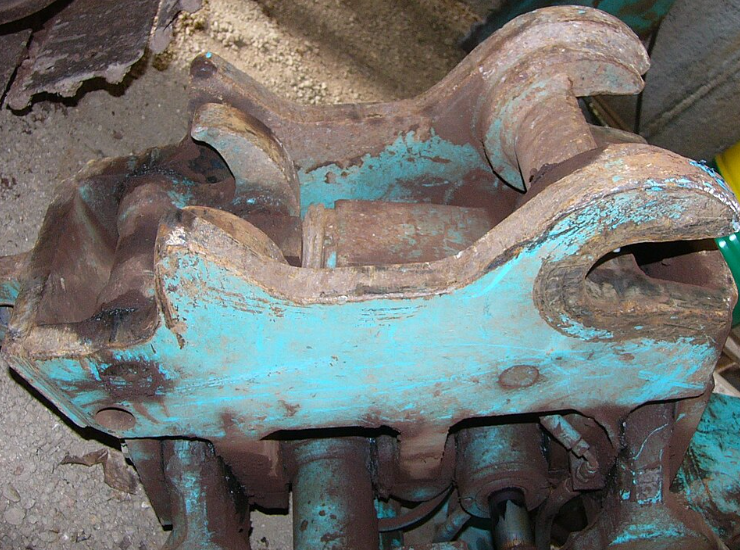
Axles and Joints of Mobile Machinery

Machinery downtime that costs money for every hour of construction or during the farming season: re-hardening the worn bearing surface rather than replacing the forged shaft.
These articulation components (excavator arms, loader booms, agricultural hitches) are subjected to continuous friction, which causes gradual wear on the diameter, while the core of the part retains its mechanical properties.

DED allows for the precise rebuilding of the worn section to restore it to its nominal dimension, offering a cost-effective alternative to replacing an entire forged shaft—a process that is often expensive and not always readily available from stock.
This dimensional repair approach is particularly well-suited for machinery fleets where downtime incurs direct costs (construction sites, agricultural seasons).

Precise control of the deposited thickness also ensures compliance with the tight fit tolerances specific to these mechanical connections.

Original nominal size restored → Shaft re-machined—a cost-effective alternative to a completely forged shaft.
Less downtime → Ideal for fleets where every hour of downtime costs money, whether on construction sites or during the farming season.
Axles and Joints of Mobile Machinery
Photo: FNQ - Wikimedia Commons — License — modified image

FAQ

Why rebuild an axle instead of replacing it?

Because a complete forged axle is expensive and not always readily available in stock, even though only the bearing is worn out.

Does the refit comply with the fit tolerances for the joint?