Repair & Remanufacturing | Reliability Enhancement & Hardening | Manufacturing & Prototyping

Energy & Environment

Gicam technology can use DED laser cladding to repair critical components in the energy and environmental sectors, such as wind turbine shafts and hubs, turbine blades, wellheads, and process valves. It enables targeted cladding and anti-corrosion coatings on expensive equipment with long manufacturing lead times.
Repair & Remanufacturing

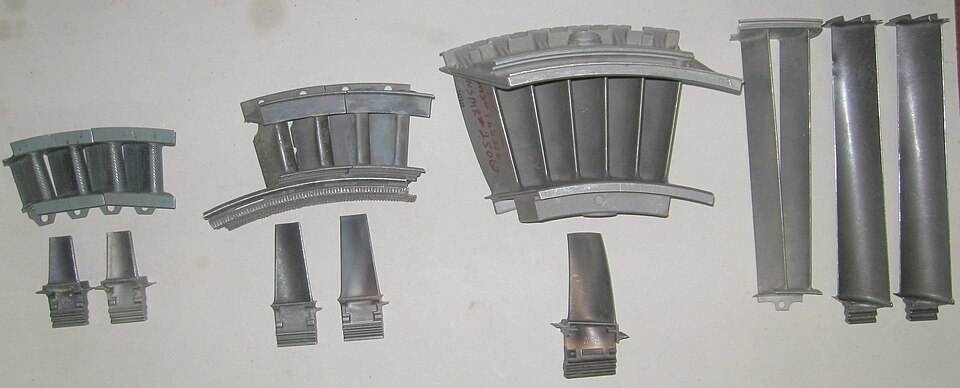
Gas and steam turbine blades

Erosion at the leading edge and tip of the blade: Replacing the eroded section with a compatible superalloy restores the geometry without having to wait for a new blade.
These components experience wear and erosion concentrated at the leading edge and the blade tip, areas subject to particle erosion, high-temperature oxidation, and contact with the housing during operation.

DED allows for the precise cladding of these critical areas with nickel-based superalloys (Inconel 625/718) that are identical to or compatible with the base metal, restoring the original blade geometry and length.

This repair avoids the need to replace a blade with a new one, which is costly and has a long lead time, particularly for high-power turbines where each stage contains numerous blades. Precise control of the heat input is essential here to preserve the single-crystal or grain-oriented microstructure specific to these high-performance components.

Geometry restored → Repairs made to the leading edge and tip; restoration to the original blade length is possible.
Preserved microstructure → Precise thermal control required for single-crystal/grain-oriented structures.
Gas and steam turbine blades
Photo: Janhuisman42 - Wikimedia Commons — CC0 1.0 — modified image

FAQ

Can DED restore a worn turbine blade to its original length?

Yes, re-coating the leading edge and tip allows the original blade geometry and length to be restored using a compatible superalloy.

What superalloys can be used for this repair?