
Repair & Remanufacturing | Reliability Enhancement & Hardening | Manufacturing & Prototyping

Energy & Environment

Gicam technology can use DED laser cladding to repair critical components in the energy and environmental sectors, such as wind turbine shafts and hubs, turbine blades, wellheads, and process valves. It enables targeted cladding and anti-corrosion coatings on expensive equipment with long manufacturing lead times.
Repair & Remanufacturing

Wind Turbine Main Shaft and Bearing Supports

A forged shaft with a production lead time of several months, damaged only at its bearing seats: remanufacturing rather than replacing it changes the logistical equation, especially in offshore operations.
This solid forged shaft transmits torque from the turbine to the gearbox/generator and experiences localized wear or corrosion at the main bearing seats, while the shaft body remains structurally sound.

The DED allows these bearing surfaces to be precisely re-machined to restore them to their nominal dimensions, a far more cost-effective alternative than replacing a forged shaft, which has a very long manufacturing lead time (several months).

This repair is particularly critical in offshore applications, where access to the nacelle is limited to favorable weather windows, and where it can avoid the need to transport heavy components via specialized vessels (jack-up rigs or floating cranes)—an operation whose logistical costs often exceed the cost of the part itself. Precise control of the heat input is essential to preserve the shaft’s fatigue strength, as it is continuously subjected to cyclic loads and sudden impacts caused by wind gusts.
Return to nominal dimension → Precise re-machining of the flanges is possible without replacing the entire forged shaft.
Limited logistics → Repair possible near the site
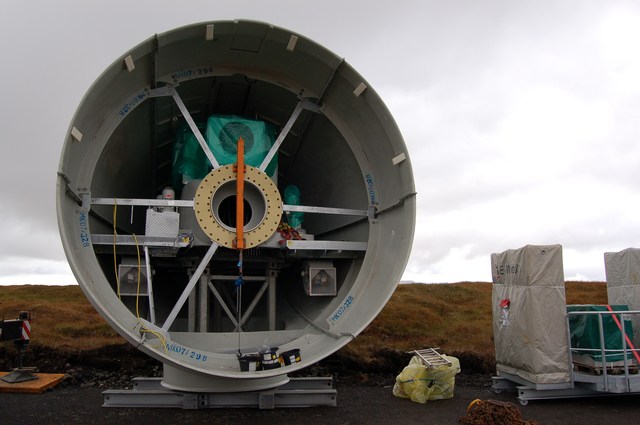
Rear section of a wind turbine nacelle
Photo: John Allan - Wikimedia Commons — CC0 1.0 — modified image

FAQ

Is it possible to repair a wind turbine's main shaft without replacing it?

Yes, the repair process can target only the damaged bearing surfaces, which avoids having to replace a forged shaft that would take several months to manufacture.

Why is this repair particularly useful in offshore operations?